


Houston has already felt the first wave of World Cup traffic. Now with a high-stakes July 4 match approaching, officials are prepared to keep the city moving, using real-time data, adaptive signals and other tools developed by the Texas A&M Transportation Institute (TTI).
“Houston is no stranger to major special events,” said Mike Vickich, a TTI software engineer based there. “With the World Cup, there are a lot of people from around the country and the world who are not familiar with our transportation system. These events also impact the people who live here, so it’s our goal to make the impact of all these extra cars on the road as minimal as possible.”
People are also reading…
Houston traffic during the World Cup: a real-time stress test
Instead of relying on static plans, TTI and its partners are monitoring conditions as they unfold and adjusting as needed. The greatest surges in traffic have followed the matches, when everyone is leaving the stadium at the same time.
Vickich said TTI’s decades-long partnerships with local agencies make a major difference in managing these surges.
“Data is the foundation of better decisions; it’s about how we turn that data into tools to help the traveling public and transportation community.”
“One of the unique things about Houston is our partnerships: TxDOT, the city of Houston, Harris County and Metro,” said Vickich. “TTI’s role is to bring those agencies together — their data sets and resources — to make the technology work and be more responsive.
“Data is the foundation of better decisions; it’s about how we turn that data into tools to help the traveling public and transportation community.”
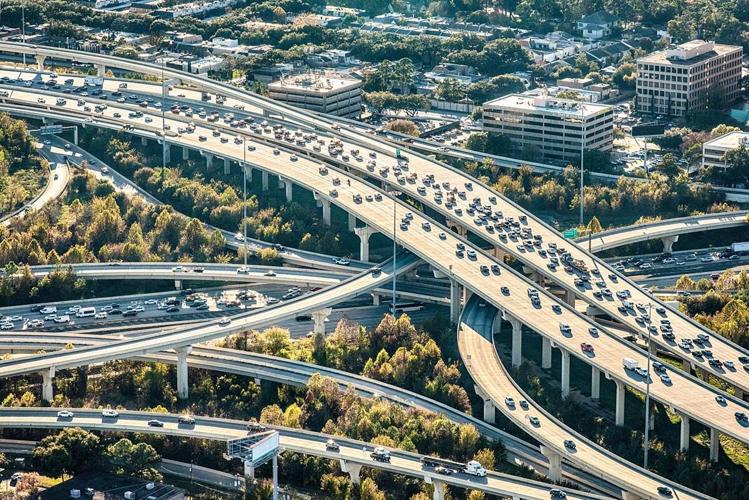
Leading up to the matches, some predictions of the strain on Houston’s already crowded roads were dire, but Vickich said the system has outperformed those expectations.
“Planning efforts considered a range of possible traffic impacts, including some very challenging scenarios,” he said. “So far, actual conditions have been more manageable than those higher-end projections, thanks in part to coordinated planning, real-time monitoring and the ability of agencies to respond as conditions change.”
World Cup dashboard tracks speeds, travel times and road conditions
To stay ahead of congestion, transportation operators first need visibility: knowing what’s happening across the region at any given moment.
In partnership with Houston TranStar, TTI has developed a web-based dashboard that tracks travel times, speeds, traffic volumes and road conditions along major routes serving NRG stadium. It’s being used inside Houston’s FIFA command center to monitor conditions and coordinate responses. The dashboard combines speed and travel-time data, roadside sensor data, camera feeds and snapshots, and incident information, gathered from multiple sources, and combines them into a user-friendly hub.
“The information is there, but it’s scattered across agencies,” said Darrell Borchardt, Houston-based TTI senior research engineer. “The dashboard has been really helpful for pulling all that data into one resource that is useful for travelers and transportation officials alike.”
Adaptive traffic signals respond instantly as demand shifts
Watching traffic is not enough — cities have to respond as conditions change.
Along the IH‑610 corridor near NRG Park, TTI supported deployment of an adaptive signal system that adjusts traffic light timing based on changing conditions. Unlike traditional signals that follow preset schedules, the system shifts throughout the day as traffic builds and clears.
“We’re able to see how fast the traffic is moving and then based on those speeds, we can adjust the signal timings,” Vickich said. “That flexibility is especially important when travel demand spikes around match times.”
Real-time event data feeds into navigation apps
Many drivers rely on navigation apps; TTI works with partners to integrate event data into apps.
“We’re pushing information to Waze and Google Maps,” Vickich said. “We realized that a lot of foreign visitors are not familiar with the local tools, but they know about navigation apps. So getting our information to those apps is increasing our reach.”
World Cup data will shape traffic planning long after the final match
While traffic is being managed in real time, the long-term value comes from what agencies learn afterward.
“The goal is to identify what worked, where traffic flow improved and how those strategies can be applied to future events,” Borchardt said.
TTI is collecting travel time, speed and traffic volume data across key corridors to understand how the transportation network performs under World Cup conditions. That data will be compared with other major Houston events, such as Texans games and the Houston Livestock Show and Rodeo.
Applied research, for good
Major events put extraordinary pressure on transportation systems, but they also create an opportunity to rethink how cities move people.
From on-the-ground monitoring to adaptive signals and integrated traveler information, Houston’s World Cup preparations offer a model for managing mobility at scale.
“This is what applied research is all about,” Vickich said. “We’re helping innovate at the forefront, developing tools that can actually be used in the real world.”


