


Throughout history, the discovery of new alloys has been the catalyst for dramatic technological developments. Today, new metals and alloys are critical to improving areas such as energy, aerospace, defense and healthcare. But the rate of discovery remains too slow to meet industry needs.
A $2 million grant to Texas A&M University’s Department of Materials Science and Engineering aims to revolutionize the manner and speed with which new metallic materials are discovered, developed and tested.
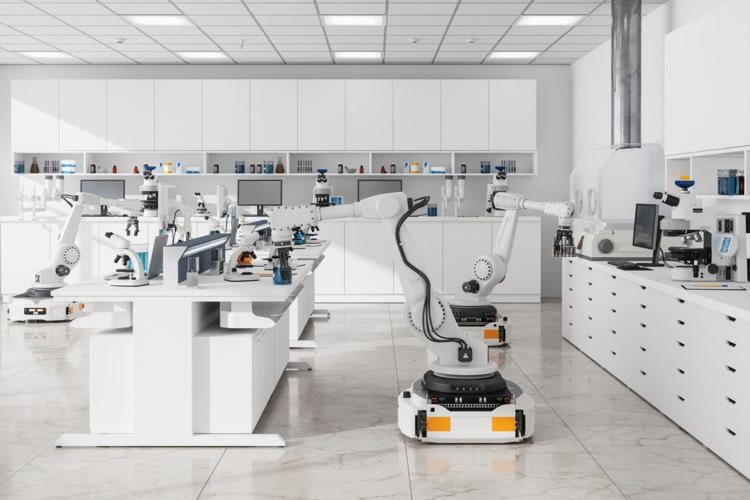
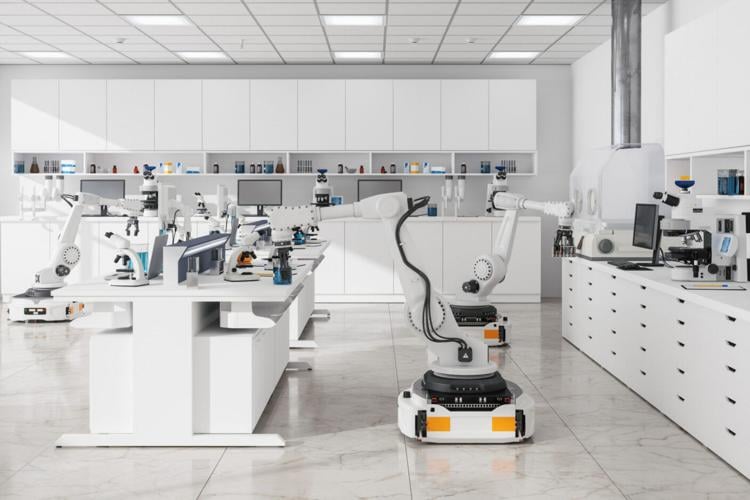
Support from the WoodNext Foundation, which manages the philanthropy of tech innovator and Roku CEO and founder Anthony Wood ’87 and his wife Susan ’89, will create the Aggie AI Foundry, a campus facility that will contain a fully automated system for developing novel metal alloys from idea generation through testing using AI brainpower and robotic workers. The automated process will increase the rate at which metal alloys are developed from months to a week or less.
People are also reading…
The Aggie AI Foundry will be the first lab of its kind in academia. Existing self-driving labs focus on materials that are relatively easy to synthesize and process, but can’t handle the complexities of designing and testing novel metal alloys at temperatures up to 3,000 degrees Celsius.
The foundry is the brainchild of Dr. Ibrahim Karaman — materials science and engineering department head and Chevron Professor I — and Dr. Raymundo Arróyave, associate department head for research and Chevron Professor II. Both are world leaders in developing algorithms and methodology for metal alloy design, having published more than 100 papers together.
“We are grateful to the WoodNext Foundation for their vision and support,” Karaman said. “Their investment allows us to pursue a bold idea: building an autonomous foundry where AI and robotics work together to accelerate the discovery of new alloys that could power the next generation of technologies.”
The foundry’s experimental framework will use physical models, algorithms and human knowledge generated by years of trial and error in the field to train AI to proffer ideas for transformative alloys. Robotics will mix, melt and test the materials for the desired qualities using computer-controlled arms that will work along an assembly line that takes samples of materials. Imagine a 3D periodic table as a wall cabinet of elements that processes them according to the directions of the AI brain.
“Dr. Karaman and I, along with our collaborators and students, know what it takes to design materials faster. And we have shown it,” Arróyave said. “But the process can still take a toll on humans.”
“You want students to be creative, but imagine they are like line cooks in a big, fancy restaurant. They want to be chefs, and we have them chopping onions and cutting tomatoes. We want to free human brains and hands to conduct more science and write papers that share these discoveries with the world.”
Currently, it’s not possible to experiment on materials using only a computer; the work must be done on the actual materials.
“The computer can predict some behavior, but there’s no computational tool anywhere in the world that can predict how an alloy is going to behave,” Arróyave said.
Using several dozen elements from the periodic table would provide AI with roughly a trillion possible ways for mixing them. The human brain doesn’t have the bandwidth to run through all that material and choose the combination most likely to succeed. But AI can discover hidden correlations between elements, make suggestions and run the experiments quickly.
“While it’s natural to have questions about AI, it can help scientists explore possibilities and make discoveries at a scale we’ve never seen before,” Arróyave said.
This research is supported through the WoodNext TAMU Fund, a donor-advised fund program. Guided by the Woods’ overall mission to advance human progress and remove obstacles to a fulfilling life, the WoodNext Foundation makes grants and investments in areas including scientific and biomedical research, mental health, homelessness, education, nature conservation, disaster recovery and economic opportunity.


