


At Texas A&M University, research isn’t just about making discoveries — it’s about making discoveries work for the people who need them most. Guided by the land-grant mission it embraced a century and a half ago, the university focuses on applied research, pursuing inquiry shaped by public need and devoted to solving problems in the real world.
By pushing knowledge forward through purposeful research, Texas A&M transforms bold ideas into solutions that benefit society. Whether pioneering advances in agriculture, engineering, medicine, energy, national defense or a host of other crucial fields, Texas A&M’s researchers aim to discover not only what is possible but also how it can make a difference.
“The land-grant heritage means that our education was never just about personal advancement; it was about preparing us to serve our communities, our state and our nation. This heritage is a constant reminder that our work must remain grounded in public purpose and real-world impact,” said Dr. Robert Bishop ’79, vice chancellor and dean of Texas A&M Engineering. “Because we focus so much on applied research, that means we are developing solutions that can be deployed into the public for the betterment of Texans and people throughout the country.”
People are also reading…
Helping a child breathe easier
Examples of these values in action can be found throughout the Texas A&M Ecosystem, demonstrating how the university puts knowledge to work for the public good through research driven by public need. In one recent case, that need began with a 5-year-old boy unable to breathe safely while he sleeps.
Because of a rare craniofacial condition, David Hardy has experienced dangerous sleep apnea off and on since he was a newborn. In certain positions, the left side of his jaw can move sideways and push his tongue over his airway, which causes dangerous drops in his oxygen levels. Despite undergoing surgery, David still struggles with his condition. In fact, Carolyn Hardy, David’s mother, has spent many nights in Connecticut holding her son’s jaw in place to prevent interruptions in his breathing.
“I would often think, ‘I wish we could just make a facial brace that would shift his jaw to where it needs to be and give him a safe airway,’” she recalled. “But I didn’t know how to build this device.”
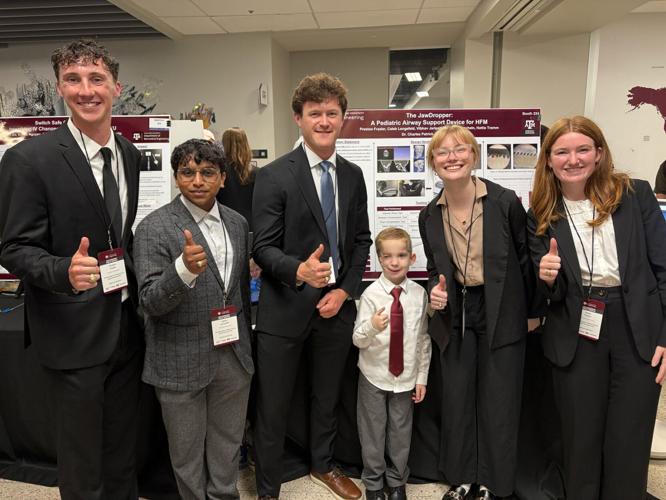
Hardy reached out to the biomedical engineering departments of more than a dozen universities but received a positive response from only Dr. Charles Patrick, director of undergraduate programs for Texas A&M’s Department of Biomedical Engineering. This initial connection eventually led to the formation of a capstone team comprising five biomedical engineering seniors who worked together to transform Hardy’s idea into a fully functional prototype.
Through a partnership with the Southwest-Midwest National Pediatric Device Innovation Consortium and with Patrick as its faculty adviser, the team spent nine months developing, testing, improving and refining a device that eventually became “The JawDropper.”
In April, The JawDropper won the Bray International Award for first place in the biomedical engineering category at the 2026 Engineering Project Showcase, where David finally met the student engineers in person and tested out their final prototype. The team hopes its device will move toward clinical validation through further development and one day help patients with conditions similar to David’s.
“This story captures the essence of what it means to be an Aggie engineer: seeing a human need, applying technical expertise and working collaboratively to create a real-world solution that changes lives,” Bishop said. “Texas A&M engineering exists not merely to advance knowledge but to translate that knowledge into solutions that make life better for everyday Texans and, ultimately, the world.”
Built to serve from day one
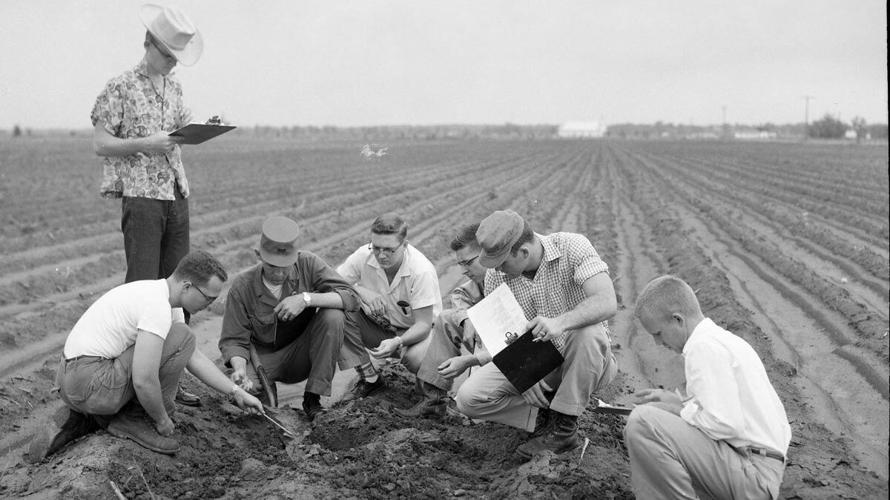
This commitment to applied research that serves the public became apparent soon after Texas A&M opened its doors in 1876. Texas ranchers and farmers came to rely on the university to conduct major scientific investigations into the urgent crop improvement and livestock health issues they faced. In the ensuing decades, Texas A&M expanded its research into civil engineering, transportation infrastructure, petroleum geology and other fields as technological advances opened new avenues for scientific inquiry.
Today, Texas A&M is a research powerhouse with the capacity to advance discoveries, shape industries and deliver solutions that matter. The university has led Texas in research expenditures since it broke the $1 billion threshold in fiscal year 2020. By fiscal year 2025, annual research expenditures totaled $1.433 billion. With more than 4,300 faculty members, nearly 82,000 students and over 130 research centers and institutes, Texas A&M offers a vibrant academic environment that fosters inquiry and innovation. In this environment, collaborative research projects bring together researchers, students, industry, government and communities to tackle pressing challenges and develop solutions that serve the public good.
And although Texas A&M’s founders and initial class of just six students couldn’t have even dreamed of a research enterprise of this exceptional size and scope, the needs that inspired the university’s earliest research efforts have not disappeared. They have evolved alongside the people, industries and communities Texas A&M serves, prompting researchers to develop new approaches to long-standing challenges.
“Many of the challenges are the same ones we faced generations ago, but our approaches have changed,” said Dr. Jeffrey Savell ’75, vice chancellor and dean for agriculture and life sciences at Texas A&M. “Water has always been a limiting factor. Where earlier generations drilled wells to irrigate, we now breed crops that produce more with less. Pest control was a problem then and it still is, but instead of relying on broad pesticide use, we now develop pest-resistant crops and put beneficial insects to work.”
Those evolving solutions are visible across Texas A&M AgriLife Research, and some have reshaped entire industries. Since 1993, Texas A&M has led the Boll Weevil Eradication Program, which the Association of Public and Land-Grant Universities calls one of the most effective public-private partnerships in U.S. agricultural history. It has driven the beetle that once ravaged American cotton to the brink of elimination, raising Texas producer returns by $5.5 billion and boosting yields by 30% to 40%.
Today, similar work unfolds across Texas — in the Panhandle, the Rio Grande Valley and the ranchlands between. When drought tightens its grip on the Texas High Plains, growers turn to hard red winter wheat varieties bred for the region by AgriLife Research wheat breeders. In the Rio Grande Valley, a team led by Dr. Kranthi Mandadi spent 15 years developing a treatment made from spinach-derived peptides to help citrus trees survive huanglongbing, the most devastating disease facing the citrus industry. The treatment earned Environmental Protection Agency approval for commercial use earlier this year. And in South Texas, entomologists are working to stay ahead of the cattle fever tick, one of the greatest threats to a Texas beef industry worth roughly $8.5 billion a year, developing new vaccines and using GPS tracking to map the pest’s hidden strongholds.
In a constantly changing world, new challenges emerge frequently. Texas A&M has always been quick to respond, working toward novel solutions to urgent problems whenever the need arises. An AI-powered tool for detecting early signs of Alzheimer’s disease, self-healing plastic, 3D-printed medicine and other recent innovations confirm the university’s status as a hub of dynamic research and demonstrate how Texas A&M is working to be not only the best university in the world but also the best university for the world. But these innovations represent only a few of the many domains where Texas A&M’s research is making a difference.
“One of the areas where we have always made and continue to make contributions is national defense. Hypersonic flight is one of the critical areas that we are concerned about because there are threats utilizing hypersonic flight vehicles. If we’re going to protect our country, we need to understand the technology,” Bishop explained. “We have, I would say, the best hypersonic tunnels and the best hypersonic programs in the country by far. There’s nothing like what we have and what we’re building. That is an example of a land-grant mission. Why is that? Because that’s not pure research — that’s actually applied. That’s actually solving real problems that we are facing as a nation.”
Solving the problems of today while anticipating those of tomorrow requires more than individual breakthroughs. It requires the scale, collaboration and strategic vision to bring people and ideas together across disciplines and institutions. That is the trajectory Texas A&M’s research enterprise is now pursuing, and progress in that direction has been significant in 2026.
In her recent address to unveil the Beyond 150: One University for Good shared vision and strategic plan, Texas A&M President Dr. Susan Ballabina announced that Texas A&M aims to conduct more research while responsibly increasing the impact of that research.
“We must transform the research enterprise infrastructure and support services to enable expanded scholarly work, deepen impact across disciplines and advance fundamental and interdisciplinary research.
“Quantum science, for example, could reshape how we solve problems ranging from the Texas power grid and cybersecurity to national security and precision agriculture. Building on capabilities such as our VISION supercomputer and growing expertise across the university, we have an opportunity to become a leader in areas like this that will define the future,” she explained.
Ballabina introduced Aggie Research Commons, a novel initiative that will assemble experts from diverse disciplines in collaborative hubs to drive potentially life-changing advances.
“These interdisciplinary hubs will organize people and expertise around major challenges such as health and life sciences, energy and extreme weather to reach a level of collaboration we have never seen before, and we will reward faculty through the promotion and tenure process for their commitment to interdisciplinary research,” she said.
In addition, Ballabina revealed efforts to explore the clinical partnerships necessary to establish a Texas A&M-branded hospital, which would increase the university’s research impact in the critical realm of health. She also touched on the growing importance of space exploration, pointing to the tremendous research potential of the soon-to-open Texas A&M Space Institute and the aerospace medicine program’s groundbreaking work in improving human health and performance in space.
Throughout the address, Ballabina’s focus was clear: The purpose of the university’s research enterprise is not merely to study real-world problems but to solve them.
“Texas A&M enters its next 150 years as one of the premier public research universities in the world with tremendous momentum and an even greater obligation to put that strength to work. … We must be bold and brave in the pursuit of building a brighter, safer world by creating an environment that fosters research as a force for good,” she said.
It has been 150 years since farmers and ranchers first turned to a young Texas A&M for solutions to the challenges they faced, and the university continues to deliver answers and drive innovation through service-focused applied research. The outcomes of this work are as consequential as they are diverse, ranging from improved food security and a safer nation to a little boy who can breathe safely as he sleeps soundly through the night.
“That is what research as a force for good looks like. It starts with discovery, but it does not end there. It reaches people,” Ballabina said. “That brings us back to our land-grant purpose. Texas A&M must enrich the communities we serve. That means creating stronger relationships between researchers and communities. It means supporting local communities and addressing their challenges involving infrastructure, health, agriculture, energy and economic development. It means building academic and cultural programs that strengthen the places where people live and work. And it means using the extraordinary footprint of this university to help Texas thrive.”
As Texas A&M’s research enterprise continues to evolve and expand under the strategic guidance of purpose-driven leaders, the university remains steadfast in its land-grant promise to ensure that every inquiry, discovery and innovation serves the greater good — now and for generations to come.
Built to serve: Texas A&M’s land-grant heritage and 150 years as a force for good
For a century and a half, Texas A&M has partnered with communities, industry and government to turn education, research and extension into real-world solutions for the people of Texas and beyond.
At the heart of the land-grant mission is the belief that higher education can transform lives by expanding opportunity, developing potential and preparing people to put what they learn to work in service to others.
Part three: Research • Reading now
Beyond discovery: Research with purpose thrives at Texas A&M
As a land-grant university, Texas A&M conducts research driven by public need and a sense of service, uniting inquiry and expertise to turn knowledge into solutions that make a real difference in the real world.
Part four: Extension • Coming soon
When knowledge becomes action: The impact of extension at Texas A&M
Through extension, Texas A&M turns innovation into tangible impacts, fulfilling its promise to serve Texas, the nation and beyond.


