


Rural Texas communities may know which roads flood first, where wildfire threats are growing or which systems are most vulnerable in a major storm. But limited staff, time and technical resources can make hazard mitigation planning difficult to carry through.
A new $2.9 million initiative from Texas A&M University’s College of Architecture aims to help rural jurisdictions do just that. The Texas Mitigation Planning Initiative (TMPI) will help rural communities create or update hazard mitigation plans that identify steps communities can take before disasters happen to reduce damage.
Over the next three years, TMPI will work with at least three rural regions across Texas. Each selected region will bring together multiple communities to develop plans that are ready for approval and easier to update in the future.
People are also reading…
The initiative is led by Jaimie Hicks Masterson, director and principal investigator of TMPI, and funded by the Texas Division of Emergency Management and the Federal Emergency Management Agency (FEMA)’s Hazard Mitigation Grant Program.
“This is about saving lives and limiting property damage,” Masterson said. “With a growing population, more and more development, and more catastrophic disasters, rural Texans need capacity and technical support to reduce disaster loss. This project exemplifies Texas A&M’s land-grant mission to provide a public service to communities in need.”
Strengthening local capacity for disaster planning
Hazard mitigation planning helps communities identify the actions they can take before disasters happen to reduce risk and future damage. Those plans also open eligibility for certain federal funding opportunities when a disaster occurs.
In many cases, a mitigation project must be included in an approved plan before a community can apply for funding to carry it out.
However, for smaller rural communities, the process can be difficult to manage alone.
“With limited hands, it is an immense challenge just to respond to a disaster, let alone think strategically about how to reduce risk in the first place,” Masterson said.
But it can create a Catch-22, Masterson said. In some counties, local governments can operate as “a one-person machine,” with one official juggling emergency management, public works, elected positions and other day-to-day responsibilities at once. That can leave little time for the coordination, documentation and public input required to complete a hazard mitigation plan.
“Without a hazard mitigation plan, when they are hit by a disaster, they will receive little to no federal funds for reconstruction,” Masterson added.
TMPI is designed to help communities through that process while also preparing local leaders to maintain and update their plans over time.
“TMPI is not here to hand communities a plan and walk away,” Masterson said. “We will train emergency management coordinators to build the knowledge and confidence they need to update those plans every five years and carry the work forward on their own.”
Hazards don’t stop at county lines
Rather than working with one county or town at a time, TMPI will focus on multi-county rural regions. Communities can define those regions themselves, as long as they are willing to work together.
Program coordinator Seth Jordan said the regional approach reflects how many natural hazards affect Texas communities.
“Rivers don’t care about county boundaries,” Jordan said. “When a river floods, it floods three, five, 10 communities at a time.”
Planning at a broader regional scale can help neighboring communities identify shared projects that may later be eligible for mitigation funding.
For example, neighboring communities might agree to share debris management services or to support upstream flood sensors that help multiple downstream areas prepare and respond.
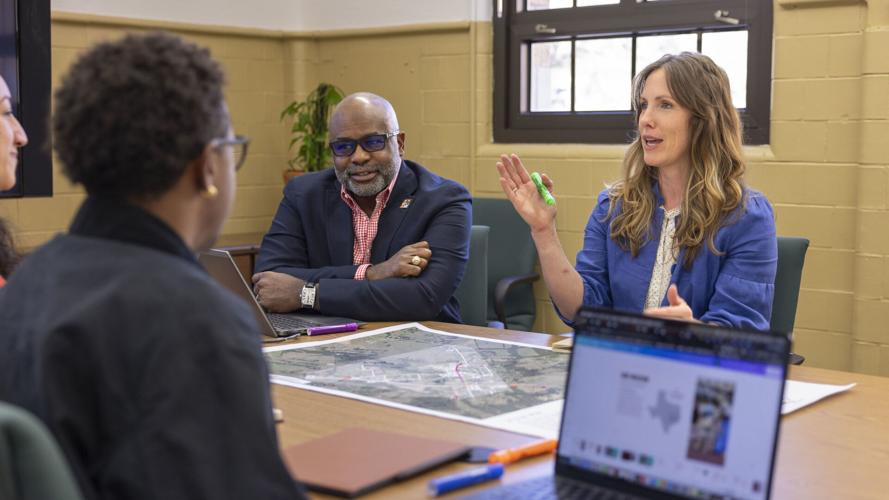
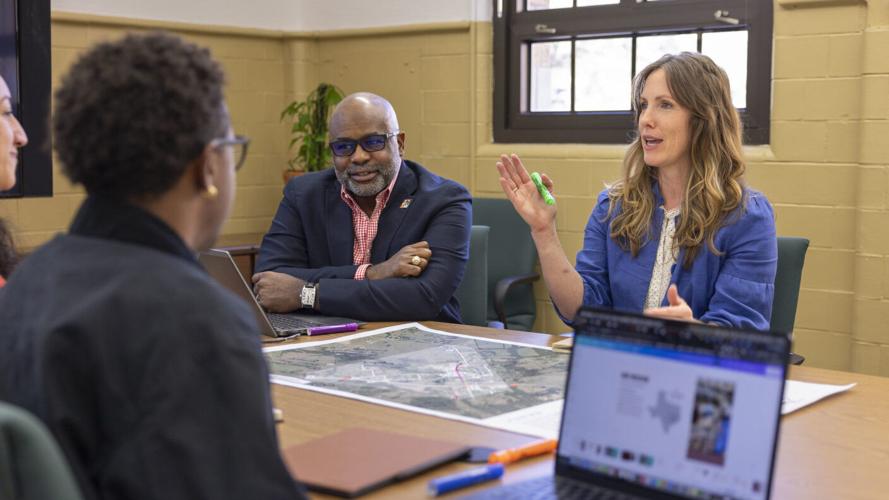
Through workshops, coaching sessions and planning support, each selected region will work with TMPI staff to shape a plan that reflects local needs. Communities will form a small team of local staff and officials to guide the work and gather feedback from local stakeholders throughout the planning process.
“We also seek to support TDEM in reaching their goal that every county in Texas has a FEMA-approved hazard mitigation plan,” Masterson said.
A partnership built for rural planning
TMPI brings together experts from two College of Architecture programs with complementary strengths in community planning and disaster resilience: Texas Target Communities (TxTC) and the Hazard Reduction and Recovery Center (HRRC).
TxTC has spent decades partnering with communities to help address local needs and strengthen local capacity. Masterson, TxTC program director, said that its role is to help rural communities lead the planning process themselves.
“Our strength lies in guiding places through this process, facilitating conversations and documenting the community-led strategy,” she said.
The HRRC is known for its work in innovative hazard research, mapping and planning support to disasters across Texas and beyond. Dr. Michelle Meyer, director of the HRRC, said it will help fill data gaps that often exist in rural areas. She said national datasets may be less detailed and local officials may not have the staff or tools to gather that information on their own.
“We will use our research experience to collect new data that will provide a detailed fact basis to decide how to best invest hazard mitigation resources,” Meyer said.
Support for every step of the process
Texas A&M experts will help participating regions move through the planning process with support in every step of the process, including facilitation, mapping, community engagement and plan development.
TMPI will also hire additional mitigation planners dedicated to working directly with participating communities.
Current Texas A&M undergraduate and graduate students will also have opportunities to engage with TMPI. Meyer said they will gain hands-on experience in planning, data analysis, technical writing and community engagement while supporting participating communities.
“Students will learn and practice a versatile set of skills while also demonstrating the Aggie core value of selfless service,” Meyer said.
TMPI is seeking interest from rural regions across Texas that are ready to collaborate. The initiative will prioritize regions that are willing to work across county lines and areas that either lack a FEMA-approved plan or have plans that are significantly out of date.
“We’re looking for places that are ready and willing to work together,” Masterson said. “We know that rural areas have limited capacity and we know that the planning process — bringing people together, having conversations — is just as important as the plan itself.”
County emergency management coordinators interested in learning more should contact TMPI program manager Seth Jordan at sjordan@arch.tamu.edu.


