


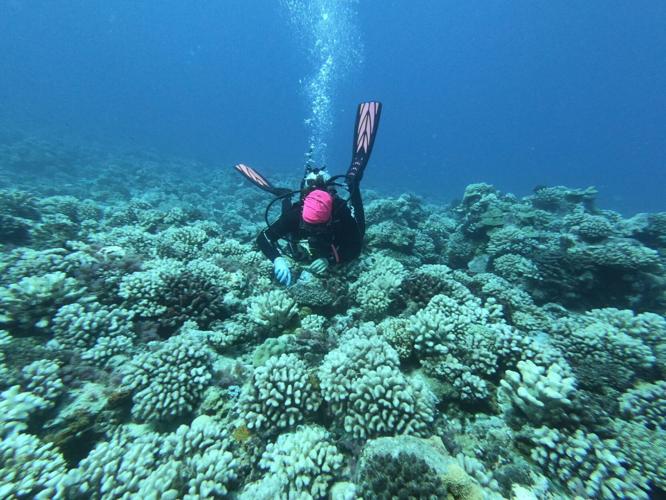
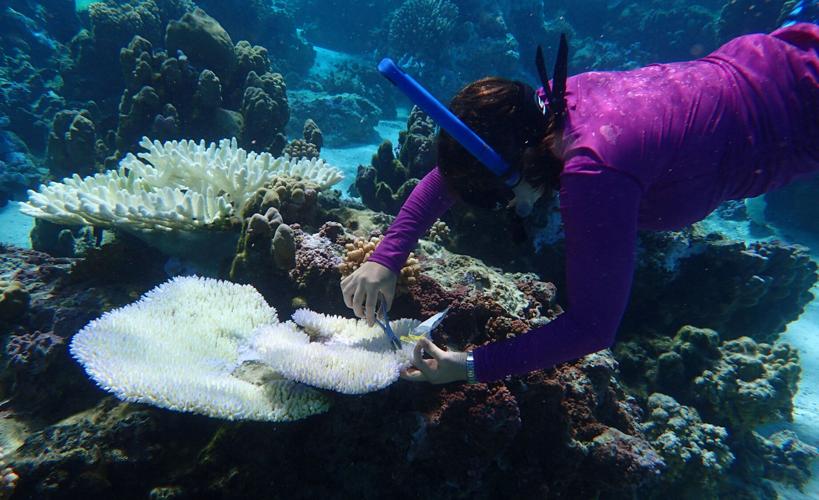

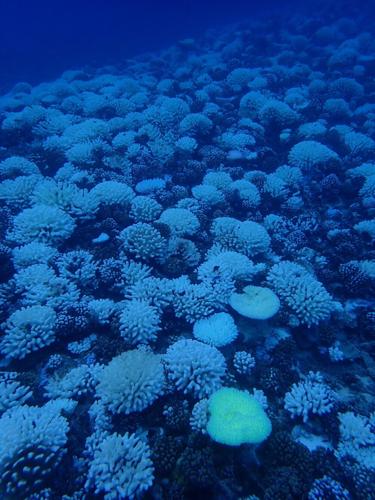
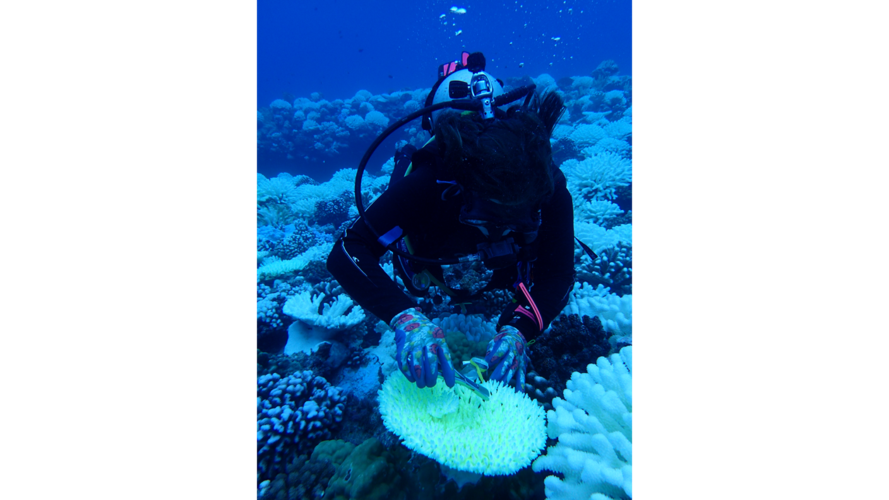
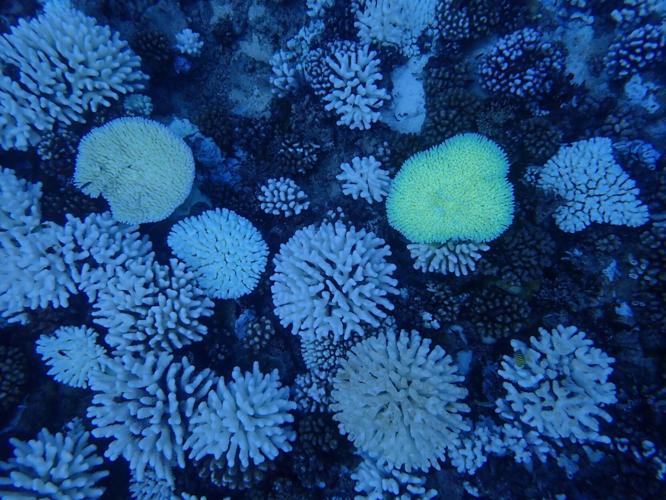
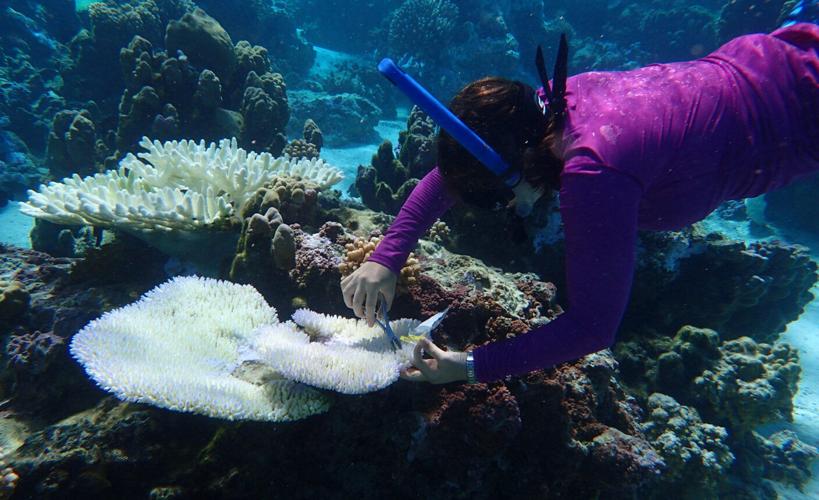
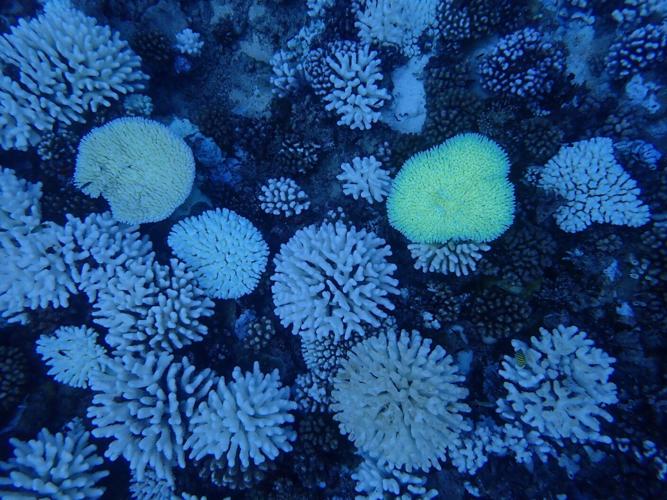
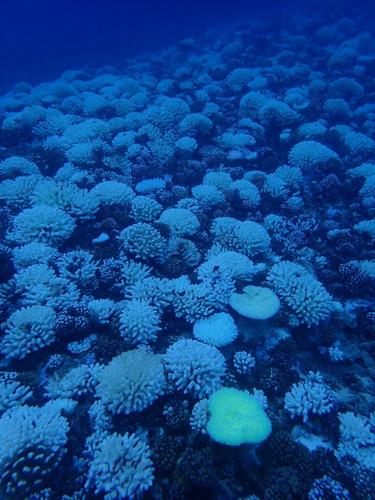
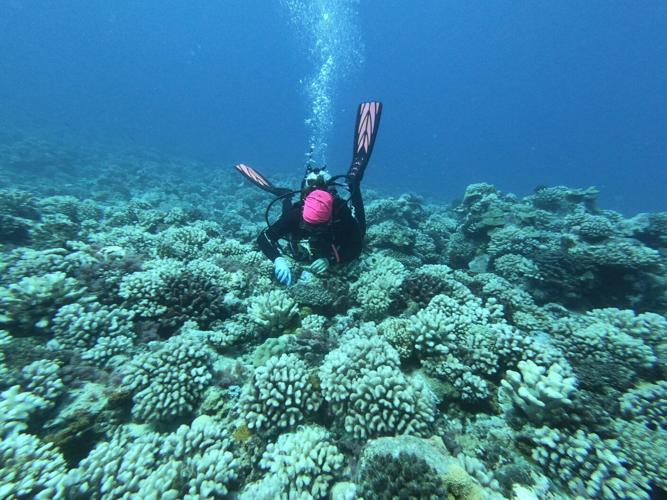
The 2019 heat wave that struck Mo’orea — a volcanic island in French Polynesia — swept through its coral reefs like an invisible wildfire.
Colorful, lively corals bleached into ghostly, chalk-white skeletons, as soaring ocean temperatures triggered a mass mortality event (MME) that wiped out up to 80% of some local coral populations.
To anyone peering through the turquoise water, the vibrant ecosystem had transformed into an underwater graveyard.
Yet hidden among the dead was remarkable evidence that the reef had already begun rewriting its future; a glimpse of evolution in action, unfolding in real time.
By collecting and sequencing hundreds of coral genomes before, during and years after the devastating 2019 heat wave, a multi-institutional team led by Texas A&M University College of Arts and Sciences researchers, working alongside collaborators from the University of California, Texas Tech University, Boston University, Arizona State University and Auburn University, uncovered one of the clearest records of rapid evolution in the wild.
People are also reading…
The findings, published in Evolutionary Applications and supported by the U.S. National Science Foundation, revealed that corals carrying genetic variants linked to heat tolerance were more likely to survive and reproduce following a heat wave-driven MME.
Even more striking, some of the advantageous, heat-tolerant genetic variants were passed down to the offspring of the next generation, leaving behind a clear genetic blueprint for survival.
“Coral mortality may not be the end of the story,” said Dr. Marie Strader, lead researcher of the project and marine molecular ecologist in the Department of Biology at Texas A&M. “Genetically speaking, and for certain populations, it may be the beginning of a new one.”
Survival of the hottest
Mass mortality events act like a powerful genetic filter: corals unable to withstand the intense and prolonged heat waves are more than likely to perish, while the survivors become the architects of the reef’s future.
“That evolutionary shift matters because coral reefs are far more than underwater landscapes,” Strader said.
Although they cover less than 1% of the ocean floor, coral reefs support more than a quarter of all marine life, providing habitat for thousands of species while protecting coastline communities from strong waves and storm surges.
“Think of them as the rainforests of the sea,” Strader said. “Coral reefs promote biodiversity, support economies, tourism and food sources of all sorts. After an MME, it’s not just the local coral populations that are affected, it’s really the entire ecosystem.”
Understanding which corals survive, and more importantly why they do, has become one of the most urgent questions in marine science. So, rather than documenting the devastation left by a marine heat wave, the researchers were also interested in whether the survivors left a lasting imprint on the reef’s DNA.
The answer was clear: yes.
Mass mortality events are, of course, an ecological force, but what we are showing is that they act as a selective force, too.
In other words, the same heat waves that collapsed much of Mo’orea’s reefs also helped determine which corals would build their future, by causing heat-tolerance genetic variants linked to survival to be passed directly down to their offspring.
Still, Strader cautions against interpreting the findings as a guarantee of long-term coral survival, because evolution is not necessarily a rescue plan to rising ocean temperatures.
“There are a lot of implications when we think about coral recovery and conservation,” Strader said. “These kinds of mass mortality events are becoming more common. So thinking about how to study the genetic consequences of them could be helpful for future coral population growth and conservation.”
Evolution may be giving corals a fighting chance. Whether rising ocean temperatures gives them enough time to use it remains another question entirely.
The genomic timeline
To capture the evolution of corals in the wild, the researchers assembled a genomic timeline of 349 coral colonies across Mo’orea.
“One of the aspects that makes this research project so unique is that we analyzed the corals both spatially — across different habitats — and temporally, across multiple points in time,” Strader said.
By comparing coral genomes before the heat wave, surviving adults afterward and juveniles born years later, the team was able to detect shifts in genetic variations across a coral generation.
The genomic analyses led by Dr. James Fifer, postdoctoral fellow in the Strader Lab at the College of Arts and Sciences, showed that the survivors had adaptive signatures and passed down some of their genetic blueprints of heat tolerance to their offspring.
Put simply, the next generation of corals were born with a genetic head start for survival against deadly heat waves.
“It’s a significant step forward in our understanding of coral survival and persistence,” Strader said. “Genomic variations for heat tolerance were passed down, and the next generation was born with a potential advantage in warming oceans.”
The color of collapse, the ghostly warning
Healthy corals owe their brilliant coloration to billions of microscopic algae living within their tissue. These algae convert sunlight into energy, supplying as much as 90% of the fuel that corals use to grow, build and survive. In return, corals shelter the algae and provide them with essential nutrients.
But when prolonged heat waves push the relationship to its brink, their partnership starts to unravel, and a haunting transformation follows.
“It’s unclear which is happening first: if the algae are leaving themselves, if the coral is kicking them out or if the coral is eating them,” Strader said. “The measurable effect is that the symbiont population rapidly depletes, and you’re left with coral tissue that looks clear and white.”
The phenomenon is called coral bleaching. Some corals can recover if the ocean’s temperatures fall quickly enough. But when heat waves stretch from days into weeks and weeks into months, energy reserves dwindle.
“The coral tissue and structures are still alive but they are starving and devoid of any symbionts,” Strader said.
Starved of energy, and without their algal partners, corals slowly weaken until they eventually perish — and when spread across several reefs, it becomes a mass mortality event.
“That’s why marine heat waves can be so destructive,” Strader said. “Corals don’t have an internal way to regulate their temperature like humans do. They’re dependent on the temperature of the water they live in.”
In essence, bleaching is the visible tragedy; evolution is the invisible aftermath.
No ‘silver bullet’ gene
The findings also confirmed that coral heat tolerance isn’t determined by a single genetic variant. Rather, it is highly polygenic, meaning it emerges from the influence of many genetic variants that together shape coral survival.
“It’s not a single ‘silver bullet’ gene for survival,” Strader said. “It’s a process of many genetic variants, each contributing and working together.”
This discovery reshapes how scientists think about evolution itself. In Mo’orea, the researchers documented genetic changes emerging in the very next generation — rare evidence of adaptation unfolding in real time, rapidly and in the wild.
“It was exciting to actually see heat tolerance-linked genetic signatures emerging in the very next generation,” Strader said. “In the context of rapidly changing climates, thinking about how ecological and evolutionary processes can be happening at the same scale, it reminds us that life is constantly finding a way to adapt.”
Across the planet, marine ecosystems are facing new pressures, new challenges and new conditions. And although Mo’orea is only one small corner of a larger ocean, at the time, it seemed as though the reef’s tale had ended.
In reality, the story was far from over. Beneath the bleached remains of the reefs, evolution was already writing its next chapter in the hidden language of life itself, carrying the legacy of survival into the next generation.


